How often and when should you steam? What will you feel while sitting over the steam?
Steam with the PMOS/PCOS blend 2–3 times a week, outside menstruation. If your cycle is irregular, listen to your body and adjust the frequency of steaming to how you currently feel and what you need. Steam regularly throughout the year.
If you do not feel the same desire for warmth in summer as you do in winter, try steaming with the steam rising freely, without wrapping yourself in a blanket.
This has its own charm too — in the morning or evening, when it is not hot yet or is no longer hot. After steaming, you can also rinse yourself with lukewarm water, which is very refreshing and pleasant, as the external cooling intensifies the feeling of warmth inside.
In winter, remember to wear warm socks and, as well as sealing in the steam around your waist, drape a blanket over your shoulders.
After steaming, lie down for at least 30 minutes and let the warmth spread through your body. In the evening, you will drift off to sleep beautifully.
Think of steaming as an at-home wellness ritual, rather than a treatment. It is a balneological procedure that uses hydrotherapy, thermotherapy, aromatherapy and phytotherapy, and its main purpose should be to help you connect with your body and relax. You can find instructions on how to prepare it here.
As a complement to steaming, you can use the cooled herbal decoction to rinse your intimate area, or pour hot water over the herbs and drink them as tea after steeping for 5–10 minutes. It has a delicious taste.
About the condition and its new name
The name PCOS (polycystic ovary syndrome) described a condition involving cysts on the ovaries. However, 25% of women do not have cysts at all. The original name also overlooked the fact that this is a complex condition with endocrine and metabolic connections, whose manifestations affect more areas of the body than just the ovaries. For this reason, on 12 May 2026, following years of discussion among experts, the name was changed to PMOS (polyendocrine metabolic ovarian syndrome). A three-year transition period was established alongside it, during which the terminology is to change gradually in professional materials, healthcare systems, research and guidelines. (Link to the medical journal The Lancet)
PMOS:
Polyendocrine – the condition has a complex hormonal nature and affects multiple endocrine systems and their mutual regulation.
Metabolic – metabolic changes, such as insulin resistance, are an important part of the condition. In insulin resistance, cells respond less effectively to insulin, making it harder for the body to move glucose from the blood into the cells.
Ovarian – the ovaries are an important part of the condition, and their function is influenced by the hormonal changes associated with PMOS.
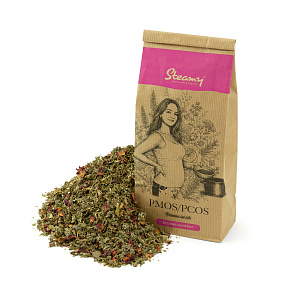
At the beginning of May, I decided to add a blend for women with PMOS to our phytotherapy range. I began gathering information about the manifestations of the condition and matching medicinal plants to them. I read through research, and after several weeks, an original formulation emerged, based on findings from modern science and traditional herbalism.
I believe that with this specially formulated steaming blend, I can help women with PMOS feel better in their bodies and relax over the rising steam from herbs blended with expertise and consideration for their needs.
This is not a miracle cure, but support for the female body with a specific need, centred on relaxation, calming the mind and easing the impact of this condition.
I empathise with all the women who do not stand alongside others at the starting line of their reproductive health, but are crowded at the back, overlooked and often deliberately unseen, because there is no clear solution to their health problem that the world of modern medicine can boast about.
All the more so because the outward manifestations of PMOS can be so visible that women with this condition struggle not only within themselves, but often also with the world around them, which does not forgive being different and judges with a critical eye where it should look with kindness.
Symptoms of PMOS:
- Menstrual disorders (irregular or painful periods), long menstrual cycles
- Excessive hair growth on the face, chest or abdomen (hirsutism)
- Hair loss
- Difficulty maintaining weight
- Sleep disorders
- Dark patches of skin on the neck or in the armpits
- Infertility
- Insulin resistance
- Enlarged ovaries with ovarian follicles
If you have some of the symptoms listed above — you do not have to have all of them — I recommend seeing a gynaecologist who can confirm or rule out PMOS. Sometimes, receiving a diagnosis can itself bring relief.
The blend’s ingredients
Our original blend is based on the pharmacognostic profile of the individual plants and findings from current research into their biologically active substances.
For legislative reasons, however, I cannot describe the effects of the herbs here, so I will refer to some of the studies I found in connection with the individual herbs.
The blend contains spearmint, which has the highest-quality studies available among all the herbs used. These suggest that spearmint tea may offer a possible alternative to antiandrogen therapy for mild hirsutism (https://pubmed.ncbi.nlm.nih.gov/17310494/) and has antiandrogenic potential in women with PMOS. https://pubmed.ncbi.nlm.nih.gov/19585478/
Another herb studied in connection with PMOS is marjoram. The authors of the study (https://pmc.ncbi.nlm.nih.gov/articles/PMC13041406/) concluded that marjoram tea may have a beneficial effect on the hormonal profile of women with PCOS, particularly by reducing adrenal androgen levels, and may also improve insulin sensitivity.
Rosemary contains bioactive substances with antioxidant and anti-inflammatory potential that may be relevant to mechanisms associated with PCOS. (https://www.degruyterbrill.com/document/doi/10.1515/bmc-2022-0038/html)
Yarrow, together with fennel, which our blend does not contain, led to increases in oestrogens, progesterone and follicle count, and a reduction in testosterone in laboratory mice. https://pmc.ncbi.nlm.nih.gov/articles/PMC13111933/
Finally, my favourite raspberry leaf, which you can also buy separately for tea here, was among the five herbs that researchers administered to rats as part of the TCM-based Wuzibushen blend. The blend affected testosterone, SHBG (sex hormone-binding globulin) and androgen receptor expression, and improved certain indicators of ovarian follicle development. https://www.tandfonline.com/doi/full/10.1080/09513590.2023.2190808
I used rose to fine-tune the blend’s aromatic component and soften its character.
I am aware that the research I considered concerns herbs consumed as teas, and that some of it was conducted only in laboratory settings. Not all of the studies provide strong evidence, but they were helpful when gathering information and describing the herbs in the blend. That is why I formulated the blend in proportions suitable for herbal tea, and the herbs we work with are tea-grade.
Why steam with PMOS?
Women steam because it is pleasant and calming. One benefit of steaming is the relaxing effect of warmth on the pelvic area, which is part of the complex communication between the reproductive organs, the nervous system and hormonal regulation. An important system within this is the hypothalamic–pituitary–ovarian (HPO) axis.
Warmth, touch, fragrance and a feeling of safety provide the body with various sensory and emotional stimuli that can influence the activity of the autonomic nervous system, body perception, muscle tension and overall experience. And that is exactly what women with PMOS need.
Try sitting over the steam before bedtime — perhaps you will sleep sweetly too.
If you have any questions, write to me at monika@steamy.cz. I will be very happy to share my experience with you.

Mgr. Monika Valová